Zoom Link: https://utexas.zoom.us/j/4185242032?pwd=cLalRchmkhgGiUcxel32J0xij7O3yb.1
A Novel Shapley Value-Based Framework to Track Spatiotemporal Dominance Transitions of Flood Drivers in Compound Flooding

Md Enayet Chowdhury, Ph.D. Student
B.Sc. (2019), M.S. (2024), Bangladesh University of Engineering and Technology
Advised by Dr. Jun-Whan Lee
Hurricane-induced compound flooding can result from the interaction of coastal storm surge and river flow from upstream inland, with the dominant flood driver changing across space and time during an event. Existing flood driver dominance classification approaches can identify surge-dominated or river-dominated spatial regions but often provide limited information on how dominance changes with time throughout a storm. To address this limitation, we developed a framework that quantifies storm surge and river flow contributions to compound flooding using Shapley values derived from ADCIRC simulations.
The analysis uses a triangular unstructured mesh of the Houston-Galveston region with 293,511 computational nodes. For each of 14 historical storms, Shapley values are calculated from three ADCIRC configurations: compound flooding, surge only, and river only. Each node is then classified at every time step into four states: surge-dominated, river-dominated, transitional, and undefined.
The results show distinct transition patterns among storms. During Hurricane Beta, the change in flood-driver dominance progressed from the offshore Gulf toward the inner bay. Hurricane Harvey showed an opposite pattern, with river influence expanding from river-connected areas toward the lower bay and offshore Gulf. The proposed framework therefore provides a quantitative basis for comparing the timing and spatial progression of flood-driver transitions across different storms.
Geometry-Aware Neural Operators for Cross-Regional Storm Surge Prediction

Hyunje Yang, Ph.D. Student
B.Sc., M.S. from Seoul National University
Advised by Dr. Jun-Whan Lee
Rapid storm surge prediction is essential for emergency response and coastal risk assessment. However, most existing surrogates are tied to the coastal region on which they were trained. Extending these models to unseen locations requires additional hydrodynamic simulations and model retraining, limiting their scalability for data- and resource-constrained coastal communities.
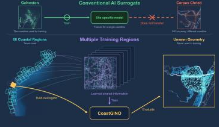
Moreover, many surrogates rely on regular grids and are therefore not readily compatible with the unstructured finite-element meshes commonly used in operational coastal hydrodynamic models. Here, we present a geometry-aware neural operator that learns storm surge dynamics directly on unstructured meshes and generalizes across diverse coastal geometries.
The models were trained using storm surge simulations generated with the ADvanced CIRCulation (ADCIRC) model for 446 synthetic tropical cyclones (TCs) along the Texas Gulf Coast. We evaluated two prediction tasks:
- Site-specific prediction, where models were tested on unseen TCs within a fixed coastal region.
- Cross-regional prediction, where a single model was tested on both unseen TCs and unseen coastal regions.
The proposed operator used local geometric information to adaptively weight and aggregate features from neighboring mesh nodes. In site-specific evaluations, several deep learning architectures performed well, but their errors increased by more than threefold when applied to unseen coastal geometries. In contrast, the geometry-aware neural operators remained more robust under cross-regional transfer and reduced prediction error by more than 20% relative to the best-performing baseline.
These results demonstrate that explicitly representing local mesh geometry is essential for transferable storm surge emulation on unstructured coastal domains. Geometry-aware neural operators therefore provide a promising pathway toward scalable storm surge prediction without developing and training a separate model for every coastal region.