Himadri Sarker
B.Sc. in Civil Engineering (Bangladesh University of Engineering and Technology, BUET)
M.Sc. Civil Engineering (The University of Texas at Austin)
Zoom Link: https://utexas.zoom.us/j/84804724445
Abstract

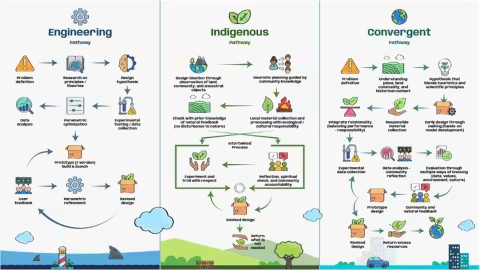
Water treatment technologies frequently fail to achieve lasting adoption when design processes overlook Indigenous and local knowledge systems and cultural contexts. Converging Indigenous and scientific knowledge systems can create pathways toward more adaptive, inclusive, and culturally responsive water innovation. Conventional engineering design emphasizes hypothesis-driven, iterative problem-solving guided by physical laws, material science, and functional optimization. In contrast, traditional Indigenous practices, such as Navajo basket weaving, integrate material functionality and empirical observation with cultural, spiritual, and ecological knowledge. The Navajo basket-weaving process begins with careful observation of ancestral baskets to understand their form, function, and construction, while drawing upon knowledge passed down through generations. Examining these complementary design approaches offers a framework for community co-design that integrates scientific principles with Indigenous ways of knowing, fostering more empathetic, context-sensitive, and sustainable water treatment innovations.